Monday, May 3, 2010

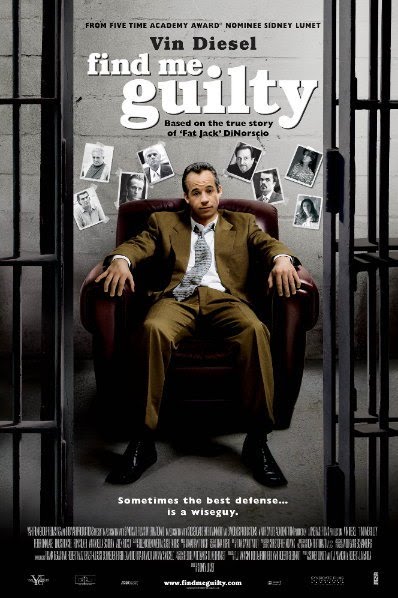
Find Me Guilty (Lumet 2006)

(While the move is being a pain in the butt, here is another classic review till I finish the Bad Lieutenant: Port of Call New Orleans review)


Find Me Guilty is perhaps the most frustrating type of movie to review simply because of what it is: a professionally made, solidly written, directed and performed film that is completely lacks any distinguishing features to make it memorable. Of course, when you have a director as great as Sidney Lumet who gave us 12 Angry Men, a statement such as the one I made might still be seen as damning. It shouldn’t be, but the film never reaches the highs or lows that make a great director’s work worth discussing. After considering Find Me Guilty from all angles, the conclusion I reach is that there are better Sidney Lumet films, better Vin Diesel films, better court room dramas, better court room comedies, and better mob films that one should seek out first.

The film is based on the true events of the longest criminal trial in US history as an entire New Jersey mob family is arrested and to be put on trial all at once. One of these mobsters is Jackie DiNorscio (Diesel) an aging man already convicted for a drug charge in a separate case. DiNorscio is approached by DA Sean Kierney (Linus Roache, aka Bruce Wayne’s dad), who will get DiNorscio’s prison sentence reduced if he testifies against his associates. Instead, DiNorscio refuses and chooses to defend himself in court, with occasional advice from lead defence attorney Ben Klandis (Peter Dinklage). What results is a slightly absurd trial as DiNorscio’s generally loveable personality becomes the center of focus, much to the frustration of the prosecution.

The film is not so much about the court case itself, but rather an examination of DiNorscio’s unfailing sense of loyalty to his mob family and his inability to differentiate between personal ties and business ties, even when such loyalty seems misplaced. When the film opens, Jackie is nearly killed when his cousin shoots him several times: Jackie believes his cousin still loves him deep down and is simply in need of help for a drug problem, hence his refusal to turn him over to the police. Jackie, as played by Diesel, is not innocent of the crimes accused but does have an innocent view of the world. He does not seem to understand why people could possibly dislike him or doubt that he loves them. Kierney is the exact opposite of Jackie, a man who is legally innocent and right but is so personally arrogant and dislikeable that the viewer almost entirely sides with Jackie despite of the evidence.

This binary opposition of the characters is part of the problem with the film though. In one of the film’s best scenes, Kierney lets loose his frustration about the jury finding Jackie likeable and its impact upon their society, noting that after all, these men are murders and thieves. However, the viewer is never really left in conflict. Jackie is such a nice guy that we never really are left to see the other side of his life. In fact, the crimes Jackie has been involved with are pretty much swept away from the view of the viewer. Meanwhile, Kierney's horrible personality is in full display, ending any chance of conflicting ambiguity.

The end result of all of this is that there is no drama. While the film is interesting, it never becomes involving, leaving the film as little more than a collection of moments, of interesting scenes that really don’t add up to a whole lot. This is shocking given that, as noted, Lumet made perhaps the most intense court based films ever made in 12 Angry Men. Whereas each member of the jury in that film had distinct personalities and viewpoints,in Find Me Guilty, the supporting cast has nothing to work with. Dinklage and Ron Silver have very little to do, and the entire mass of the mob is nothing more than a series of Italian mafia stereotypes.

Worse, the film has a made for cable feel about it, from adequate but not great production design to shoddy makeup. The film is supposed to be set in the 1980s, but nothing in the film ever manages to feel evocative of the era. And while Diesel does his best as an actor here, the makeup he is given does not look natural, never allowing the viewer to believe in the supposed age of his character. The film would have been better served by casting an older actor in the role, and given the likeable but not overly bright approach taken to Jackie in the film, one could easily have seen Sylvester Stallone in the role. Yes, I am being serious.

I could say more about Find Me Guilty, but there really is not that much left. The film is a minor work for all involved, and is fine if there is nothing else to watch. But with all the possible choices one has, that will leave this film near the bottom of the pile

Thursday, April 29, 2010

UPDATE

Greetings folks!

Over the next little bit, I am going to busy moving, so updates will consist of a few classic reviews and one of two new ones over the next week.

Monday, April 26, 2010

The Losers (White 2010)


The sad thing about The Losers is that for its entire running time, you can tell the filmmakers were trying hard to make this film work. This isn’t a half assed effort of a film; from the directing of Sylvain White to the acting, everyone brought an A level effort to the film, and you have to admire that. The problem is none of that effort ultimately makes The Losers a decent film going experience.

A partial update on the premise of the 1980s television cheese fest The A-Team, The Losers is an adaptation of a mature readers’ comic book series of the same name, following a group of special operations soldiers who are left for dead and framed for the murder of a group of children in Bolivia by their handler Max (Jason Patric). Understandably angry, the group takes up the offer from a mysterious woman named Aisha (Zoe Saldana) to bankroll their return to America in exchange for killing Max. This is only the start of their troubles however as group tensions and the mysterious identity of Aisha threaten to unravel the whole scheme.

The material is standard action fare, but workable for a fun, if vapid, film. So why does The Losers ultimately not work? While the film suffers from several flaws, they are all the result of the film’s attempt to achieve the rarified status of “cool.” While there are many things in both life and film which hope to become cool, the common denominator for most things which do become cool is that don’t actively seek to gain that status, but rather have the status of “cool” pronounced upon them by the culture in a natural way. Actively seeking the status of “cool” more often than not achieves the opposite result, and it is this problem that dodges nearly every moment of The Losers.

The type of “cool” which the filmmakers behind The Losers wish to achieve is clear from the outset, as they try and blend 1980s style “men on a mission” action films with the pop culture soaked wit and syntax of the post-Pulp Fiction era of American filmmaking. The characters which populate this world are media saturated individuals who wear this knowledge on their sleeves and take little of what happens around them in an overly serious fashion, not being quite as ironically detached as some of Quentin Tarantino’s characters while never being as ethically obsessive as Jason Bourne.

What the filmmakers miss however is that the films they are trying to emulate, even at their most frothy, tend to have a better sense of grounding which never exists in this film. While the popular culture may be the way in which many people structure and express their views of the world in both real life and in film, the important thing is that such expressions are still about something tangible. Randal of Clerks and Clerks 2 fame may spend most of his time discussing pop culture, but his choices of topics and the way in which he chooses to talk them tell us much about his concerns, thoughts and ideals. Even the absurd macho posturing of the military unit in Predator tells us something about those characters, as simple as it may be.

The same cannot be said about the characters of The Losers, where nearly every character mouths off in and endless series of light banter which exists solely to be light hearted banter. Consider the characters of Jensen (Chris Evans) and Pooch (Columbus Short): I can honestly tell you next to nothing about these characters because there is nothing to say. One has a wife and another a niece, but those details amount to little. I cannot even tell you which one for sure is the obligatory smartass of the group, because their dialogue is frequently interchangeable. This is not the fault of the actors at all, as they make due with what they have. The problem is that they have nothing of substance to work with, transforming the film into more of a sketch comedy than an action comedy.

The villains fair no better than the heroes in the film, if not worse because they are nearly cartoons with no menace to them. Oh yes, Jason Patric is amusing to watch as Max, but at no moment is he ever a credible threat. He is a bad guy because, well, the film needed a villain, and therefore he must do villainous things. We are constantly reminded about how dangerous he and his organization of criminals are, but we are never actually shown anything to make us believe that. The Losers make frequent note as to how tough and frightening Max’s right hand man Wade (Holt McCallany) is, but the film never gives you one moment to believe that concept. Instead, we are treated to some admittedly funny scenes of misunderstandings, banter and frustrations between the super villain duo, but they would have worked better in an outright parody of the genre than in this film.

All of this is all the more annoying because there are nice moments and elements in the finished production. Chris Evans manages to come out of the film totally unscathed, thanks to a natural charisma and comic timing that rises well above the material, and the idea of environmentally friendly terrorism is an amusing idea, even though it goes nowhere in the film. And I would be remiss if I didn’t point out the excellent the use of Journey on the soundtrack in the film’s best moment.

That is just the point though: the film is nothing but moments. I honestly cannot recommend The Losers as anything more than a time killer if you actually have some time to kill. It is an entirely disposable film, likely to be forgotten about as soon as it is over, a point that no film wanting to be cool can ever survive.

Saturday, April 24, 2010

Cash on Demand (Lawrence 1961)


While audience discussions of film might seem to indicate otherwise, rarely ever is it the overall plot which makes or breaks a given work. After all, take a look at perhaps the most popular genre in film at the moment, that of the superhero. Breakdown these films to their bare basics, and you will find a similar overall structure and story which repeats time and again, be it Superman, Batman or Spider-man. This is the same of all genres.

No, what most often makes a work is not the plot, but the details, which shape a work and give it the texture that makes it memorable. It is in the details where the subtext is to be found; it is in the details where the subtleties of character and drama are to be made or lost.

Take the film we are examining today, Cash on Demand. This 1961 suspense thriller from director Quentin Lawrence sounds like a typical heist film, with an innocent bank manager (Peter Cushing) blackmailed by a cunning crook (Andre Morell) into robbing the bank during operating hours. However, instead of being a standard bank heist film, Cash on Demand is a crime thriller update of Charles Dickens’ classic tale A Christmas Carol, exploring class relations in post war Britain, with Andre Morell’s criminal character acting as a twisted, but likeable, amalgamation of the three ghosts of Christmas. This is achieved by smart writing, acting and directing which places emphasis on character and cinematic craft over cheap thrillers and violence, elevating the finished work into something more than a simple genre retread.

Played out real time, the first fifteen minutes or so have little to do with the robbery, but rather focus on the relationship between the bank’s chief executive Fordyce (Cushing) and his staff at a small town bank. A former soldier, Fordyce brings a military style of discipline to his branch and its operations, frequently noting that their job is to service the people of the community in an efficient and morally upright manner. However, Fordyce is totally detached from the very people he serves and, by extension, the people he works with. His service to the community is based in a very vapid ideal, believing in the structures of community, society, and most importantly, authority, without any actual understanding as to what those structures are designed to serve. This lack of understanding seems rooted in a sense of class distinction and generational difference, revealed by his contempt for the younger members of his staff and his obsession with his establishment remaining “dignified.” As played by Cushing, Fordyce is a man who conducts himself as if he were a lord, pronouncing judgments on his staff and believing in fear and respect as the most effective methods of conducting his trade.

It is these complex social and societal dynamics surrounding Fordyce’s authority and personality which explode with the arrival of Hepburn (Morell), and which become the real basis of the drama in the film. Hepburn is not a threat so much because he desires the bank’s money, but because he systematically disrupts, subverts and destroys the very symbols and structures which empower Fordyce, emasculating him and revealing his moral and ethical failings. It is here that the similarities with A Christmas Carol become increasingly apparent, as Hepburn becomes, in a perverse manner, a moral guide for Fordyce. This is all the more peculiar in that the audience is invited to not only like Hepburn, but actively root for him, despite the fact that Hepburn is threatening the lives of Fordyce family in order to gain the bank's funds.

No scene perhaps captures the central drama of the film more than a moment where Fordyce tries to stand up to Hepburn, making a declaration about how he will kill Hepburn if anything happens to his family. In what is a case of perfect acting, writing and directing, what would normally be a moment of heroic rebirth for Fordyce instead becomes a moment of great pity, as we are witness to how empty Fordyce’s threat is: it is pure posturing, with no real authority to be a credible threat. It is a magnificent scene for both Cushing and Morell, as Cushing, normally the most powerful of actors, allows himself to be shown at his most vulnerable, while Morell actually manages to subtly suggest a sense of pity on the part of Hepburn for Fordyce. It is a wonderfully layered scene, demonstrating a level of craft and intelligence missing from most modern thrillers, where the characters are often vapid stock types.

Director Lawrence in fact deserves a great deal of credit here. Working from a script from David T. Chantler and Lewis Greifer, based on a television script from Jaques Gillies, Lawarence careful utilizes the cinematic space, transforming the three room set into a rigidly defined areas designed to segregate and confine, mirroring the class and interpersonal dynamics between Fordyce and his staff. Moreover, the camerawork designed by Lawrence and cinematographer Arthur Grant is careful and controlled, at first distancing the viewer from Fordyce as we observe him, then gradually drawing the viewer into his point of view as his world falls apart.

Where the film fumbles slightly is with its conclusion, which creeps far too close towards sentimentality for a story which begs for a cynical and ambiguous conclusion. While it is a bit much to say the filmmakers cop out at this point, given that the ending was likely crafted to appease censors, it is hard not to feel slightly cheated as the film comes to a close. It isn’t a horrible ending by any stretch, but it is not nearly as satisfying as it could have been.

Regardless, Cash on Demand is well worth a rental, if not an outright purchase. Tense and well written, Cash on Demand is an example of how a stale genre can be transformed into something more by avoiding cheap, gimmicky twists and embracing character and an attention to detail that is often forgotten about in such films.

Wednesday, April 21, 2010

Kick Ass (Vaughn 2010)


Here is the truth about Kick Ass and me: I honestly don’t have much of anything to say about the film, and that is not because the film is awful in any way shape or form. I had a great time watching the film, and the film is one that is jam packed with ideas and moments designed to provoke, shock and move the audience. Everyone, from director Mathew Vaughn down to actress Chloe Moretz, has more or less nailed this adaptation of the comic, save a minor flaw or two. They have crafted one hell of a film out of the tale of a idealistic, superhero obsessed teenager (Aaron Johnson) who becomes an internet sensation after video of him fighting crime (poorly) is posted online.

So, you might be asking, if the film is so great, why am I lacking in having much to say about the film? After all, I am the man who wasted over three thousand words on the Universal Soldier films. Believe me when I say it isn’t for a lack of trying. I have come at this film in every possible way I know how, and all that came with it was pure frustration.

Instead, I have spent a good amount of time mulling over why I have felt no need to say anything about the film, and the answer only really dawned on me over the past twenty four hours. While it is somewhat odd to say, Kick Ass feels like it has already been discussed to death, torn apart and analysed in detail. This is of course absurd, as the film has only just been released. However, when you come right down to it, Kick Ass is really more or less a dramatization of the higher end of comic geek discussions on message forums across the web, about our own forms of spectatorship, our obsession with superheroes, what fantasy means to us as individuals and as a society. And much like a forum discussion, Kick Ass is alternatively insightful, horrifying, vulgar, funny and contradictory.

The catch 22 of this is that because of this familiarity, most of the propositions and satirical observations made are already familiar for the target audience. We have already had these conversations time and time again. It is fun to see these thoughts put on screen, given life, but for long term comic fans, Kick Ass doesn’t provide any new insights or propositions that we haven’t heard before, particularly having gone through the deconstruction tales of the 1980s and 1990s comics.

This leaves the general audience as being the one to which Kick Ass will have the most to offer, and this is the audience who will likely be the least receptive to the finished work, with its moral ambiguity, emphasis on geek culture and moments of grotesque violence. Even the supposed shocking nature of the violence featuring a child is not a major shock for those who have watched films such as Robocop 2 (1990), written by comic auteur Frank Miller.

In the end, Kick Ass is fun, providing plenty of laughs and, more importantly, giving Nicolas Cage a great comic character to play. Is it a classic though? I would say it is a film that is certainly of the moment, and will earn a well beloved cult reputation over the years. But it is not the big watershed event some would like to make it out to be, nor the film to push the comic to film genre to new heights. With all likelihood, the film will become lost as the decade moves on.

Sunday, April 18, 2010

War Inc. (Seftel 2008)

(Here is another classic review from my facebook days, while I work on three new reviews for the upcoming week. Enjoy!)


There is no way to talk about War Inc. (Seftel 2008) without talking about Grosse Pointe Blank (Armitage 1997), John Cusack’s cult classic comedy about a hitman who’s most recent job coincides with his high school reunion, for several reasons. First, much of the underlying structures between the two films is similar, as both revolve around their respective protagonists (Hauser in War Inc., Martin Blank in Grosse Pointe Blank) undergoing a transformation from apathetic existence to attempting some form of redemption. Secondly, in both cases Cusack is not only the star of the films, but a co-writer and producer whose influence is easily found in the finished work. Lastly, I have to consider the two films together because Grosse Pointe Blank is one of my all favourite films, which left me with high expectations going into War Inc., given it was acknowledged as being the thematic sequel to the earlier effort by Cusack himself.

To look back on Grosse Pointe Blank is to see a film which is clearly of a specific moment in time. Like many films of this period, including mainstream blockbuster efforts such as Mission Impossible (De Palma 1996) and Goldeneye (Campbell 1995), Grosse Pointe Blank reflects upon the end of the Cold War and the lives of those whose existence was defined by it. Martin Blank (Cusack), a freelance assassin, is in the midst of an identity crisis, questioning his profession and the direction that his life has taken, which has seemingly descended into a form of mindless capitalism as he works for the highest bidder. Worse, this form of greed is in the midst of being organized by fellow hitman Grocer (Dan Aykroyd), transforming the random mass of freelance hitmen into a unionized force so that they can “make more, (and) work less.”

The film’s central premise of Martin’s return to his high school and attempts to reunite with Debi (Minnie Driver), the woman he failed to take to the prom the night he signed up with the army, serves not only as a point of personal reflection but also of a metaphorical political reflection, attempting to look to the Cold War past in order to find a new direction for the country other than unrestrained greed. As Grosse Point Blank ends, it manages to find an optimism that perhaps a change is possible, as Martin and Debi literally drive out of Grosse Point and their pasts, with Grocer dead and Martin’s target alive.

Cut to eleven years later and War Inc. This time out, Cusack is Hauser, a depressed hitman working for Tamerlane, a company owned by the recently resigned Vice-President (Dan Aykroyd again), and which is running the first completely privatized war in the occupied country of Turaqistan. Hauser is ordered to the country to commit a political assassination, while hiding under the guise of being a Tamerlane executive planning a publicity stunt wedding of a Middle Eastern pop star named Yonica Babyyeah (Hillary Duff). At the same time, Hauser attempts to form some type of relationship with reporter Natalie Hegalhuzen (Marisa Tomei), who is trying to expose the sins of Tamerlane.

If Grosse Pointe Blank was an optimistic tale of being able to move past the sins of old, War Inc. is an almost hopeless film which ends on a deliberately ambiguous note (pay close attention in the final few scenes of the film), a world where Grocer won and is getting away with it, almost literally as Aykroyd’s casting as the VP insinuates. Unfortunately, the film also differs from Grosse Pointe Blank in being nowhere near as sharply written, fined tuned, or timely. Whereas Grosse Pointe Blank was riding the zeitgeist of its time, War Inc. is arriving at least a year too late, if not four, offering a pessimistic take on America’s future and politics just as the country seems to be moving in a more hopeful direction.

The main problem with War Inc. is that it goes the exact opposite route of what made its predecessor work: it places its politics before its characters, rather than allowing the politics to be subtext. The film is so overt in its politics that it feels like Cusack and crew were reading H.G. Wells before embarking on the screenplay, didactically denouncing the Bush administration’s policies while forgetting that they were attempting to make a comedy. The near future/semi-sci-fi setting of the film is gratuitous and unnecessary, and the film would have worked better by distancing itself from its very topic , at least overtly. Setting the film in a middle eastern country, fictional or real, is so in the audiences face that the characters are almost entirely reduced to caricatures, rather than real flesh and blood human beings. This could have worked had the film entered into almost total abandon with any sense of reality. Unfortunately, the film does want you to take the supposed drama of the film completely seriously and invest in its characters.

Nothing makes this point clearer than the film’s twist towards the end (MAJOR SPOILER AHEAD). As we learn during the course of the film, Hauser’s wife was murdered years before and his daughter taken, with him completely unable to locate her. However, as Hauser confronts the mysterious Viceroy (at least the film wants the character to be mysterious. It will take you all of five seconds to piece the identity of the character together once you hear the voice), we learn that Yonica is his daughter. This revelation adds nothing to the film whatsoever, rather acting as a convenient plot device. In fact, it really only seems to exist to justify the casting as Duff as a Middle Eastern pop star. Of course, just about everything involving Yonica serves no purpose in the film, seemingly instead to be a tangent about low brow American culture dominating other countries that nobody seemed to ask Cusack remove from his script. (SPOILERS OFF)

However, this is not to say the film is not worth watching. While the satire might be a bust, the character of Hauser remains strangely compelling to watch. While on the surface Hauser might seem much like Martin Blank, Hauser is a far more broken and bitter character. In one of the running jokes throughout the film that actually works, Hauser engages in forms of therapeutic conversation with the disembodied Guidestar employee, voiced by of all people Montel Williams, letting the viewer in on Hauser’s disconnect from the world around him. Furthermore, the banter between Hauser and Natalie is fairly witty and enjoyable. Nothing as quotable as the majority of Grosse Pointe Blank is, but not bad.

In fact, Cusack and the rest of the cast are solid enough. The hitman role is tailor made for Cusack and he delivers in acting, if not in the scripting this time out. Tomei makes for a good “straight man” to Cusack’s Hauser, while Duff manages to surprise by not make me hate her every minute she’s onscreen. Aykroyd however is wasted, as is Joan Cusack who tries her hardest to make every scene she is in work.

As for the direction from Joshua Seftel, it is solid, though the film is clearly the artistic efforts of Cusack more than anyone else. Seftel brings a solid hand to the film, but is hampered by the weaknesses of the script. He does have an eye for action, effectively staging a number of sequences without drifting into too much shaky cam or Michael Bay style editing.

To sum it all up, War Inc. is a well intentioned disappointment, failing to live up to its thematic predecessor or deliver upon the promise that it holds at its core. I would still recommend renting the film, but simply keeping low expectations going in.

Thursday, April 15, 2010

Hopscotch (Neame 1980)


While I am not surprised to find that Ronald Neame’s Hopscotch (1980) is a deftly crafted comedy, what took me by complete surprise is just how relevant the film remains 30 years after its original release, and 19 years after the conclusion of the Cold War. While the political landscape of the film is clearly that of the late Cold War era, and hence draws upon those tensions for its story, the film in fact is an exploration of political ideology in the broad sense, and its role in the way we choose to live our lives and run as a society, framed in this film within a generation conflict.

The story of Hopscotch is that of CIA agent Miles Kendig (Walter Matthau), a long time field agent who loves his job, only to be confronted with being tied to a desk by the young, incompetent Myerson (Ned Beatty), who cannot stand Kendig and his view of their work as being that of a game. Rather than taking this forced career change, Kendig bolts to Europe and begins to write out his memoirs, full of embarrassing secrets about the CIA, KGB and others organizations. Mailing out the first chapter to his former employers and the KGB, Kendig initiates a worldwide game of hopscotch as he tries to stay ahead of both the CIA and KGB, doing his best to embarrass both in the process.

In his review of the film, Roger Ebert gave Hopscotch faint praise and more or less dismissed the film as a lightweight romp, surprising given that the film is anything but. Oh yes, the surface of the film, with its quirky banter between characters, loveable renegade protagonist and well executed series of set pieces might appear to be insubstantial as a film, serving as little more than an escapist fantasy. Yet beneath the surface, Hopscotch is something of an expose about the ideological underpinnings of war, contrasting the beliefs of those on the ground with that of the state.

Kendig is fascinating as a character because of his reasons for being a spy rather than his skills, impressive as they be. Unlike James Bond with his imperialist overtones, or the ever ethically conscious Jason Bourne of modern times, Kendig is totally uninterested in the supposed ideological reasoning for the conflict he and others like himself are caught up in: all he does is play a game, and it is a game he loves. When visiting a Russian counterpart, Kendig reveals that he is not able to act as a double agent for the Russians, not because of any loyalty to the US of A, but because he would be terrible at the “game.” Kendig simply respects players and their level of skill, and the stakes of the conflict only manage to peak his interest rather than acting as a motivator. By all accounts, Kendig could be considered a selfish monster, willing to play a part in any conflict as long as it provides him with the excitement and stimulation he craves.

That Kendig isn’t an out and out monster due almost entirely to that fact that he is honest about this, unlike Myerson. Myerson, like Kendig, is totally driven by selfish pursuits, in this case the desire to move up the ladder of power and maintain his comfortable lifestyle. Unlike Kendig however, Myerson, more likely unconsciously than consciously, tries to hide these drives behind the party line, believing wholeheartedly in the ideological basis for their conflict with the Soviet Union. Kendig’s mission in the film of exposing the hypocrisy, stupidity and emptiness of Myerson becomes one of exposing the hypocrisy, stupidity and emptiness of the supposed ideological nature of the conflict. Kendig knows that the conflict is just a case of showing off before other players, and the anything else reduces the purity of his beloved game.

However, while the filmmakers clearly wish the audience to root for Kendig, he is also not a figure whose interpretation of the world is to be taken without question. Kendig is flanked by two key supporting characters in the film, that of his love interest and reluctant partner in crime Isobel (Glenda Jackson) and Kendig’s replacement Cutter (Sam Waterson, whose appearance here shockingly reminds us that yes, at one time, Waterson was young), who understands Kendig while at the same time chasing him. Like Kendig, both characters share a dislike of stupidity, and a detachment from the supposed seriousness of the world they live in. Unlike Kendig however, they understand fully how dangerous such ideological beliefs can be when acted upon, and thus act as a reminder for the audience, if not for Kendig, that something very real is at stake, even if it is not what fools like Myerson believe it to be.

However, I don’t want to give the impression that Hopscotch is a political treatise, as the film without question is an incredibly fun romp. Gentle in pace and style, the film is a relaxed effort from director Ronald Neame that finds its humour in its characters and witnessing how clever they are in thought and action. Chief among the joys of this is star Matthau who, as ever, is endlessly entertaining to watch, unearthing a youthful cockiness for his role that more than overcomes his physical age and ever harried face. It is something of a shame that my generation will mostly know him as having been the star of Grumpy Old Men and Dennis the Menace, as his older work constantly reminds us that he was an actor that was on par with his frequent co-star of slightly higher acclaim, Jack Lemon, who turned out films of equal greatness late in his career, unlike Matthau.

More than matching Matthau is his co-stars Jackson and Waterson, carefully walking the tightrope of grounding their characters in a sense of realism while absurdly agreeing to go along with Kendig’s plans. Beatty as Myerson is given far less to work with, playing a character that is more of a caricature, but manages to keep his character from becoming too broad despite the easy traps to have fallen into.

Without question, Hopscotch is worth seeing when the opportunity arrives (and like Carnival of Souls, is available for online rental from the Criterion Collection). In fact, it is a shame that Matthau has passed on, as a sequel to this film featuring an even further aged Kendig matching wits with an overly politically conscious and serious spy ala Jason Bourne is ripe with possibilities to extend and expand the thematic framework of this film. Alas, we’ll just have to settle for doing this ourselves.