Thursday, July 15, 2010

New Review Tomorrow, and Here is a Preview...

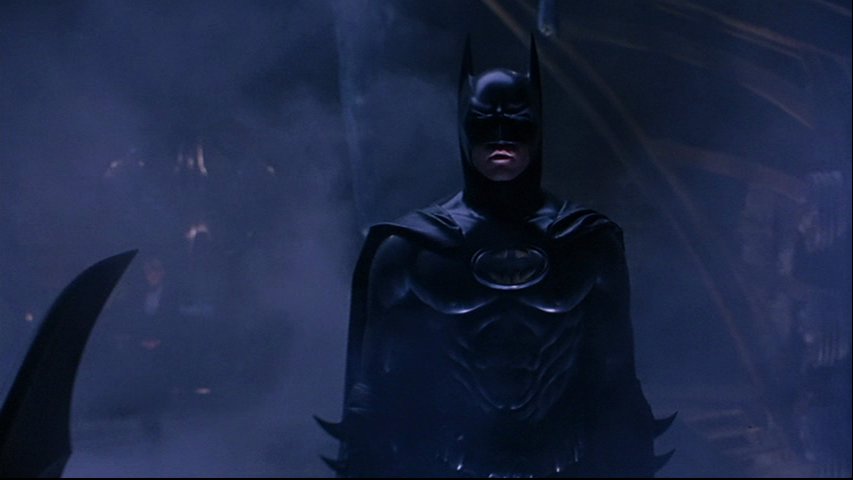
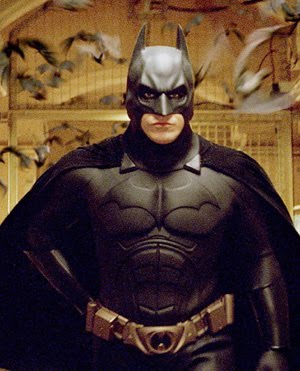
New review will be up tomorrow, but here is a slight hint at what it is. Care to guess which film from the below choices?

The Evolution of the Live Action Batman Costumes

The Batman (1943 serial)
Batman and Robin (1949 serial)

Batman: The Movie (1966)

Batman (1989)

Batman Returns (1992)

Batman Forever (1995)

Batman and Robin (1997)

Batman Begins (2005)
The Dark Knight (2008)
See you tomorrow folks!

Friday, July 9, 2010

Neighbors (Avildsen 1981)

I like to believe that in some alternate dimension, another version of the film Neighbors exists, written and directed by David Lynch with the same cast as the version of Neighbors that actually exists. In that mythic universe, we would likely have a film with a stronger understanding of the material its playing with, from the suburban middle class values and iconography that are sent up, to the fact that the film is finding its humour out of situations of sheer horror. This film would have also been the final work of John Belushi, and likely would have given him a high note to go out on with a performance that acknowledged his great talent and showed the range that most people never really took notice of during his life.

Unfortunately, in our reality, Neighbors is a film directed by John G. Avildsen, a competent filmmaker whose cinematic grasp never really extended pass the underdog sports film, which he made twice to great success (Rocky in 1976; The Karate Kid in 1984), and several other times to middling results (including The Karate Kid Part III in 1989; Rocky V in 1990). This real version of Neighbors, despite boasting some excellent performances and a script by Larry Gelbart (best known for running the television series version of M*A*S*H*), is a mess of a film, with a unbalanced tone, awkward direction and one of the most inappropriate scores I have heard for a film.

I don’t mean to pick on Avildsen, but it would be dishonest for me to say that I consider him anything more than a lesser talent. He is a competent director when he has the right script, and in the case of both Rocky and The Karate Kid, he was the right man, at the right place at the right time. However, with Neighbors, Avildsen is completely out of his depth, trying to force the material to be funny rather than trying to play it straight and allow the humour to develop naturally out of the horror.

In fact, that is the key thing which Avildsen misses with the film, that the film is first and foremost a horror story which happens to be funny. The film's narrative concerns Earl (John Belushi), a middle aged man who lives a dull life that is seemingly being systematically destroyed by the newly arrived neighbours (Dan Aykroyd and Cathy Moriarty) over the course of one night. The film is something of an early precursor to the late 1990s classic Fight Club (Fincher 1999), as Earl finds himself caught in a seemingly endless nightmare of trying to maintain his dignity, sanity and values in the face of the chaos his new neighbours bring, while still oddly being attracted to their anarchic behaviour and lifestyle. In order for the comedy to work, the repulsion and attraction that Earl feels towards his neighbours and their behaviour must be established. Unfortunately, in trying to emphasis the comedic aspects of the film, Avildsen ultimately sabotages his attempts to make the film funny.

Consider the score from frequent Avildsen collaborator Bill Conti, who manages to craft a selection of music that is memorable while being completely inappropriate for the film. Rather than working with the film as a whole, the Conti’s music overpowers the film, attempt to force the audience to find a scene funny or surreal with its mock Father Knows Best meets Twilight Zone sound. The music attracts attention to itself and never manages to feel like it belongs the film, instead coming across as some bad internet attempt at a joke dub that goes on throughout the entire film.

Luckily for Avildsen, not everything is a disaster, as Belushi actually manages to hold the film together almost single-handedly, giving a perfectly restrained performance that is far better than most film surrounding it. Belushi manages to make his Earl into a sympathetic figure, whose life is built on repressed feelings of disappointment and anger. Even more impressive however is Aykroyd, who manages to overcome the failure in direction to transform his character of Vic into a truly bizarre and sinister creature. Aykroyd’s work here is something of a watershed for him as an actor, pushing him farther than the amazing sketch comedian and straight man he had played thus far, and setting up the more dramatic performances he would later give. Unlike Belushi’s Earl, Aykroyd’s Vic is a character lacking in background and a cohesive sense of purpose, and Aykroyd’s patented mater-of-fact attitude which he brings to the role manages to give Vic a disturbing sense of purpose that another, lesser actor might have missed.

I am not sure however that I can recommend Neighbors based on the performances alone. At the end of the day, the film is little more than missed potential, and as a dark comedy is outdone by Joe Dante’s classic slice of suburban hell The ‘burbs (1989). Sadly, the best reason I can recommend it is to see Belushi giving his last ever role his all, effort that was ultimately in the service of a film that wasn’t worth it.
Thursday, July 8, 2010

Update

Review almost done, but life seems to be conspiring against me to finish it! Will be up tomorrow, in time so I can go and see Predators.

Monday, July 5, 2010

Summer Film Blues

Tonight, I had planned to have a review up, and I did finish it earlier today. However, upon rereading it, I don’t feel satisfied with it enough to post. The ideas are there, but not executed to my liking.

Instead, while I take a day or two to rewrite the review, I am going to take a few moments to make comments on a point of interest to film geeks, and will repeat this tomorrow as well.

If nothing else, 2010 could be dubbed “The Year Hollywood Looses Contact with Audiences.” Well, that is assuming it ever understood its audience in the first place. However, this year has almost unarguably been one of the worst years of film in the medium’s history, and even by the populist standards of summer blockbusters, this year has come up short.

While the mainstream press once again seems to be taking this as an opportunity to claim film dead as an artistic medium, I am oddly enough looking at this as being a potentially opportunistic situation, if studios and filmmakers pay close attention. Hollywood has been hit where it hurts most, in the wallet, and while it might take a second disastrous year for those in charge to take notice, there is the off chance that this could force them to change their business plans.

The problem with Hollywood right now is that they are all seeking to score major blockbusters, and to that end have been mostly producing homogenized, safe material, backed with obscene budgets where seemingly half of the money ends up in the hands of the “top talent.” This has usually been justified by the attraction of stars and name directors, but this line of thinking has some up short this year. When a Ridley Scott and Russell Crowe Robin Hood film cannot make back its budget, something is wrong. Hell, the fact that such a film cost over $200 million to produce, before marketing costs, should have been a clear indicator that something was wrong from the start.

While I hate to point to a remake for guidance, and while I still think that at $40 million to produce it is way too expensive for what it is, The Karate Kid, on a financial (though not creative) level should be looked to as Hollywood’s new model for most (though not all) of the film’s they produce. While it is basic common sense, lower costs mean lower risks, and potentially make riskier projects an easier sell. What is worth more to you Hollywood: one Spider-Man every year, or several District 9 type films which earn $100 plus at the box office?

In fact, I would honestly be looking towards lowering the costs of the average film to below levels of $30 million dollars. Insane you say? Perhaps. But then again, the fact that the average romantic comedy seems to cost around $40 million, when most of the film is centered around people talking, sounds insane to me.

This isn’t to say that $100 million dollar blockbuster needs to disappear, but rather that it needs to be removed from being the center point of the studio business model. Moreover, the old star system of the multi-million dollar pay days need to end, because let us be honest, it doesn’t seem to be doing jack for the selling films in the first place. And when a large part of the world is going through a recession, the fact that ANYONE is getting paid the kind of money the “A-list” crew makes is insane.

Think of the trickle down effect here Hollywood: tick prices increase because films become more expensive to produce in order to pay the costs of these wannabe blockbusters. Cut the costs, pass it on to the consumer. If the tickets get low enough, then attending a theatre might just be more affordable for many to go on a regular basis. If that’s the case, than you might just your audience attendance up, rather than relying on jacking up ticket prices to make up for lost revenue. Isn’t that better in the long term?

Maybe it is crazy for me to hope that Hollywood will learn anything like what I describe, but I would rather hope for this than accept the calls for film’s demise. Because if film were to die, than for people like me, that really is a depressing thought.

EDIT: and then there is this, which just goes to prove my point all the more -

Saturday, July 3, 2010

Terminator 3: Rise of the Machines (Mostow 2003)

(The following was originally written before the release of Terminator Salvation in 2009, and has been partly reedited for its debut here on the site)

In anticipation of this weekend’s release of Terminator Salvation (McG 2009), I have gone back and once again screened Terminator 3: Rise of the Machines (Mostow 2003), a film I’ve gone back and forth with over the years. When I first saw the film back in 2003, I enjoyed it while acknowledging that it was not anywhere near Cameron’s efforts. However, viewings since have allowed the massive flaws of the film to become increasing apparent, flaws which have tainted my views on the film quite a bit. Sadly, this viewing has only further reinforced just how much of a failure Terminator 3: Rise of the Machines ultimately is at the end of the day. Instead of a grand continuation of the story of John Connor, Mostow’s film only serves to remind audiences why Cameron’s original films work, and at the same time occasionally shows audiences that a much better film is buried somewhere in the finished mess, a film we will never get to see.

The reason the first two films work so well is the sense of reality that James Cameron built into his science fiction world. Everything felt lived in and natural, right down to the smallest detail and roles. Clothing is tattered and ruffled, the stars and extras look haggard and rough. Even the action scenes, as insane as they get, feel like news items that might get reported at eleven o’clock. This is why those films are unsettling even as you are having a blast: it is taking place in a world that very much feels like ours, with the future hell being an extension of our present existence.

What sinks Terminator 3: Rise of the Machines more than anything else is the lack of verisimilitude that Cameron mastered on the first two films. Everything in the film is too produced, too artificial: the computer effects are too clean; the sets look like sets rather than real locations. This extends even to the acting, which does not for one second feel natural. Nick Stahl never becomes John Connor; rather, what we see is Nick Stahl attempting to play John Connor. Even Arnold seems as if he is imitating his earlier performances rather than actually performing the role. This is all the more annoying given that the actors in the film have proven elsewhere that they are more than up to the task of giving the roles what they need.

This artificiality oddly enough is symbolized for me by Arnold Schwarzenegger’s jacket in this film. Take a look at the jackets Schwarzenegger wears in the Cameron films; they look like they were bought off of some random men on the street who had been wearing them for years. They were lived in BEFORE they were shot to hell over the course of those films. Now, look at the jacket in Mostow’s film; it’s clean, with carefully designed patterns throughout it. Certainly, it looks great, but it looks like a costume, a clearly made piece of professional work designed to impress rather than to wear. It appears to have just came off the rack, and nobody remembered to beat the living hell out of it before giving it to Arnold to wear.

What makes this all the more frustrating is that every so often the film manages to actually work, usually in the small character moments. A perfect example is a scene at Sarah Connor’s grave, as John remembers her final days. For a few brief moments, the film seems genuinely invested in the characters and their dilemmas, only to be interrupted by another awkward, cartoon-ish action scene that takes its inspiration from comic book films rather than James Cameron.

Then, of course, there is the ending. (SPOILERS) The end nearly redeems the film, going for broke and embracing the bleakness of the inevitable, as the world dies with John stuck helplessly in a military bunker, protected. The sleight of hand, in which the audience is deceived into thinking that, much like in Terminator 2, Judgement Day can be postponed again, works because John Connor himself believes in the possibility that it can be prevented. In any other film, this would have been fantastic. Unfortunately, this isn’t any other film. Instead, while a brilliant finish, the ending also serves as a reminder that the hour and thirty minutes leading up to it has been well below par, filled with bad sound effects, colourful lighting and bad acting. As a member of the audience, I am left to ask what the hell the filmmakers were thinking when they were working on the film. Were they asleep until it came time to shoot the ending? Or was the ending an accident, something that worked despite of the filmmakers efforts? I sadly think the latter.

So will McG do better? Well, visually for sure. However, no matter how hard he tries to reinvent himself, McG is still the man who directed Charlie’s Angles (2000), and has yet to be able to prove himself capable of anything better than that piece of trash. I hope to be proven wrong, but I’m not counting on it. Then again, I thought that the director of Breakdown (1997) would have done a better job than he did, so what do I know?

Friday, July 2, 2010

Darn It!

Ok, had to pick up an extra shift at work to cover for someone, so the review is delayed till Monday. However, will have a classic one up tomorrow.

Thursday, July 1, 2010

New review Friday

As the title says, the new review will be up Friday.